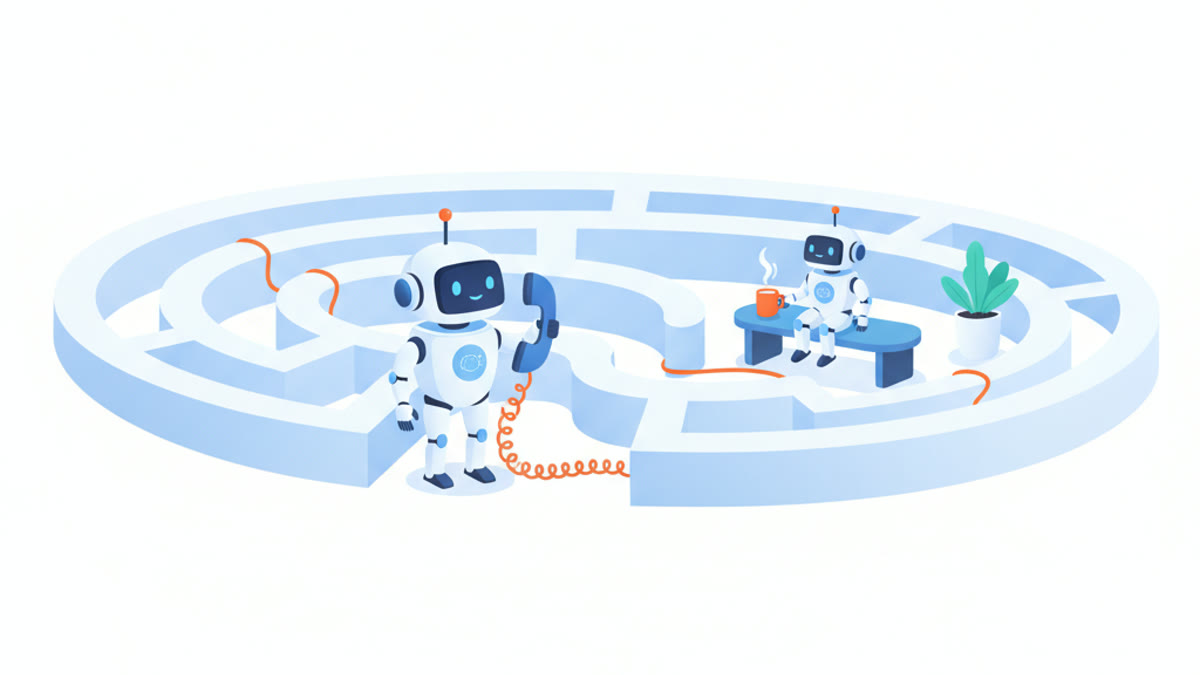
You have a list of things that need a phone call. The dentist needs rescheduling. The insurance claim needs a follow-up. The internet bill has a charge nobody can explain. Every one of those takes twenty minutes, and nineteen of them are hold music.
That is the gap virtual assistant services are supposed to fill. In 2026 there are two very different ways to fill it, and the price difference between them is not ten percent. It is closer to fifty times. Choosing badly means either overpaying by thousands a year or hiring something that cannot actually do the job you hired it for.
This is an honest comparison of the virtual assistant services worth considering, what each one genuinely does well, and where each one falls down.
Quick answer: which virtual assistant service should you use?
- You need phone calls made or answered: an AI agent that can actually dial out. Assindo is the option built specifically for this. Under $100/month.
- You need judgment, tone, and relationships: a human VA. Time Etc or Belay. $500 to $4,000/month depending on hours and seniority.
- You need writing, research, and analysis only: ChatGPT or Gemini. $0 to $20/month.
- You need all three: pair a human VA for async judgment work with an AI agent for live phone work. Most small businesses land between $400 and $2,200/month.
The rest of this guide explains why those splits fall where they do.
What changed in virtual assistant services in 2026
For years the honest answer to "can an AI assistant call my doctor?" was no. Every major AI assistant was digital-only. It could draft the email but not place the call.
That broke in 2026. Google shipped consumer agents that phone stores on your behalf, Gemini began replacing Google Assistant across Android, and Apple rebuilt Siri on cloud models. The calling capability is real, but it is narrower than the headlines suggest: Google's version is shopping-shaped, aimed at checking whether a retailer has an item in stock. The calls most people actually dread, like rescheduling a clinic appointment, disputing a bill, or sitting in a thirty-minute hold queue, are still largely unserved by the big platforms.
Meanwhile the human VA market moved the other direction. The strongest human assistants in 2026 are AI-augmented: they use automation tooling to deliver substantially more output per hour than they did two years ago. That makes a good human VA better value than they used to be, not worse.
Let Assindo answer your calls and make them for you.
Get AssindoSo the 2026 question is no longer "AI or human". It is "which parts of my workload are judgment work, and which parts are just someone sitting on hold".
1. Assindo: best AI virtual assistant for phone calls
Assindo is a managed AI agent built around real-world tasks, with phone calls as the core capability. It places outgoing calls, answers incoming ones, works through IVR menus, waits on hold, and turns what was said into tasks you can read later.
- Best for: anyone whose backlog is full of calls they keep postponing
- Key features: outgoing and incoming call handling, IVR navigation, hold queues, call transcripts and summaries, web search, social posting, scheduled tasks
- Pricing: paid plans, priced well under what a part-time human assistant costs
- Setup: no configuration or hosting; you get a number and start
- Honest limitation: it is an agent, not a relationship manager. It will not negotiate your partnership deal or write your brand voice.
The differentiator is narrow and worth stating plainly: most AI assistants stop at the edge of the internet. This one crosses into the phone network.
2. Fancy Hands: best human VA for small one-off tasks
Fancy Hands runs on a request model. You submit a task, a US-based assistant picks it up, and it comes back done. Requests are sized for roughly twenty minutes of work.
- Best for: occasional errands rather than continuous support
- Key features: calls, research, scheduling, data entry
- Pricing: from roughly $18/month for a small monthly request allowance
- Setup: immediate
- Honest limitation: you are buying a fixed number of requests, not availability. There is no real-time back and forth, and a complex task can eat a whole request.
3. Belay: best for dedicated executive assistance
Belay matches you with a specific US-based assistant who stays with you and learns how you work. This is the closest thing to a traditional executive assistant without the payroll.
- Best for: founders and executives who need continuity, not one-off tasks
- Key features: calendar and inbox ownership, travel, expenses, project follow-through
- Pricing: typically $1,500/month and up
- Setup: a matching process measured in weeks
- Honest limitation: cost and commitment. If your actual need is "someone to sit on hold with my insurer", this is a very expensive way to buy it.
4. Time Etc: best value human virtual assistant
Time Etc offers experienced US and UK assistants, generally with years of business experience behind them, at hourly rates well below a full-time hire.
- Best for: small business owners who need dependable help without an executive-assistant budget
- Key features: admin, research, social media, customer follow-up
- Pricing: roughly $30 to $35/hour with monthly packages
- Setup: onboarding in days
- Honest limitation: human scheduling. Your assistant works their hours, not yours, and an urgent 9pm task waits until morning.
5. ChatGPT and Gemini: best AI for digital work
For writing, summarising, analysis, and code, general AI assistants remain the strongest value in this list. Gemini's consumer agent tier arrived in 2026 at around $20/month, and ChatGPT sits in the same range.
- Best for: knowledge work that lives entirely on a screen
- Key features: drafting, research, analysis, code, increasingly agentic browser tasks
- Pricing: free tiers available, paid tiers around $20/month
- Setup: instant
- Honest limitation: with narrow and mostly retail-shaped exceptions, these still cannot hold a real phone conversation with your clinic, your bank, or your landlord.
AI vs virtual assistant cost: the real 2026 numbers
This is where most comparisons get vague, so here are the actual ranges.
Human virtual assistants, monthly, full-time equivalent:
- Offshore (India): roughly $800 to $2,200
- Offshore (Philippines): roughly $1,100 to $2,200
- US-based: roughly $3,500 to $7,200
- Hourly, across the market: about $5 to $75/hour depending on location and seniority
AI virtual assistants and agents, monthly:
- General AI assistants: $0 to $20
- Task and calling agents: typically under $100
- Enterprise deployments: several hundred and up
The gap between an AI agent and a US-based human VA is commonly 50x or more. That number sounds like it settles the argument, but it does not, because the two are not substitutes across the whole job. Paying $3,500/month for someone to wait on hold is waste. Paying $30/month for an AI to manage a delicate client relationship is a different kind of waste.
The useful way to read the numbers: price the hold time separately from the judgment. Hold time should be near-free. Judgment is worth paying a person for. For a fuller breakdown of what AI assistants cost across tiers, see our AI assistant pricing guide.
Types of virtual assistants, and which one you actually need
"Virtual assistant" covers at least four distinct products:
1. Human generalist VA: a person handling admin, inbox, scheduling. Strongest on judgment and tone. 2. Human specialist VA: bookkeeping, social media, customer support. Deep in one lane. 3. Digital AI assistant: ChatGPT, Gemini, Siri. Fast and cheap, confined to the screen. 4. Real-world AI agent: places calls, navigates menus, executes multi-step tasks with the outside world.
Most people who say "I need a virtual assistant" have a workload that splits across categories 1 and 4, and they buy only category 1 because it is the familiar option. That is why so many VA engagements end with an expensive human doing work that a cheap agent handles better, and a frustrated client wondering why it cost so much.
Which virtual assistant services are best for busy professionals?
If your day is meetings and your evenings are the admin you did not get to, the constraint is not capability. It is that the tasks blocking you can only happen during business hours, which is exactly when you are unavailable.
That points to a specific combination:
- An AI calling agent for anything time-boxed and phone-shaped: appointments, follow-ups, billing disputes, holds. These run while you are in meetings.
- A human VA on a few hours a week for the things that need a person: sensitive emails, vendor relationships, anything where tone matters.
The failure mode for busy professionals is buying a dedicated executive assistant to solve a problem that was mostly hold music. Start with the calls, then add human hours where judgment is genuinely required. Parents juggling the same problem may find our guide on AI agents for busy parents closer to their scenarios.
Virtual assistant services for scheduling and reminders
Scheduling splits into two jobs that people conflate.
Calendar management is coordination between people who already share a calendar system. Human VAs are excellent at this, and so are ordinary scheduling tools. You rarely need AI for it.
Booking against the outside world is the hard one: the clinic that only takes appointments by phone, the garage with no online booking, the specialist whose receptionist puts you in a queue. No calendar tool solves it, because the bottleneck is a phone call to a business that has not digitised.
That second category is where an AI agent that can call earns its keep. Reminders are the easy part. Being the one who actually sits through the hold music at 2pm on a Tuesday is the part nobody wants.
How to choose
- Your backlog is calls: an AI calling agent. This is the cheapest large win available in 2026.
- Your backlog is judgment and relationships: a human VA. Time Etc for value, Belay for dedicated continuity.
- Your backlog is documents and research: a general AI assistant at $20/month.
- Occasional errands only: a request-based service like Fancy Hands.
- A real mix: pair an AI agent with a small number of human VA hours. This is where most small businesses land, and it usually costs less than the human-only option they were considering.
The honest summary: AI has not replaced human assistants, and the services claiming otherwise are overselling. What AI has done is take one specific, miserable, expensive category of work off the human's plate. Phone calls used to require a person. In 2026, they do not.
Stop being the one who waits on hold
Your calls do not need a person. Let an AI agent make them, sit through the menus, and hand you the summary.